Blueberry Botanicals
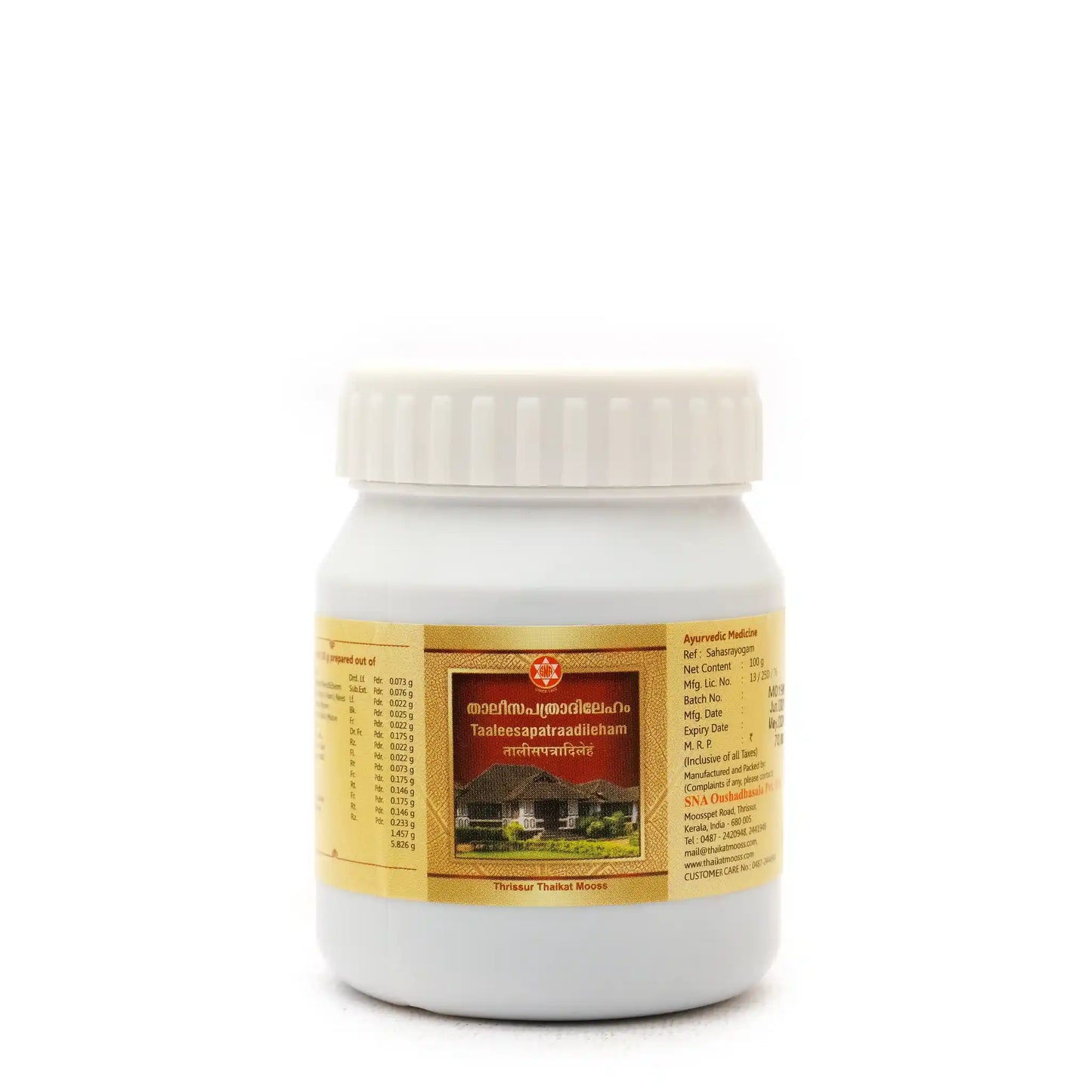
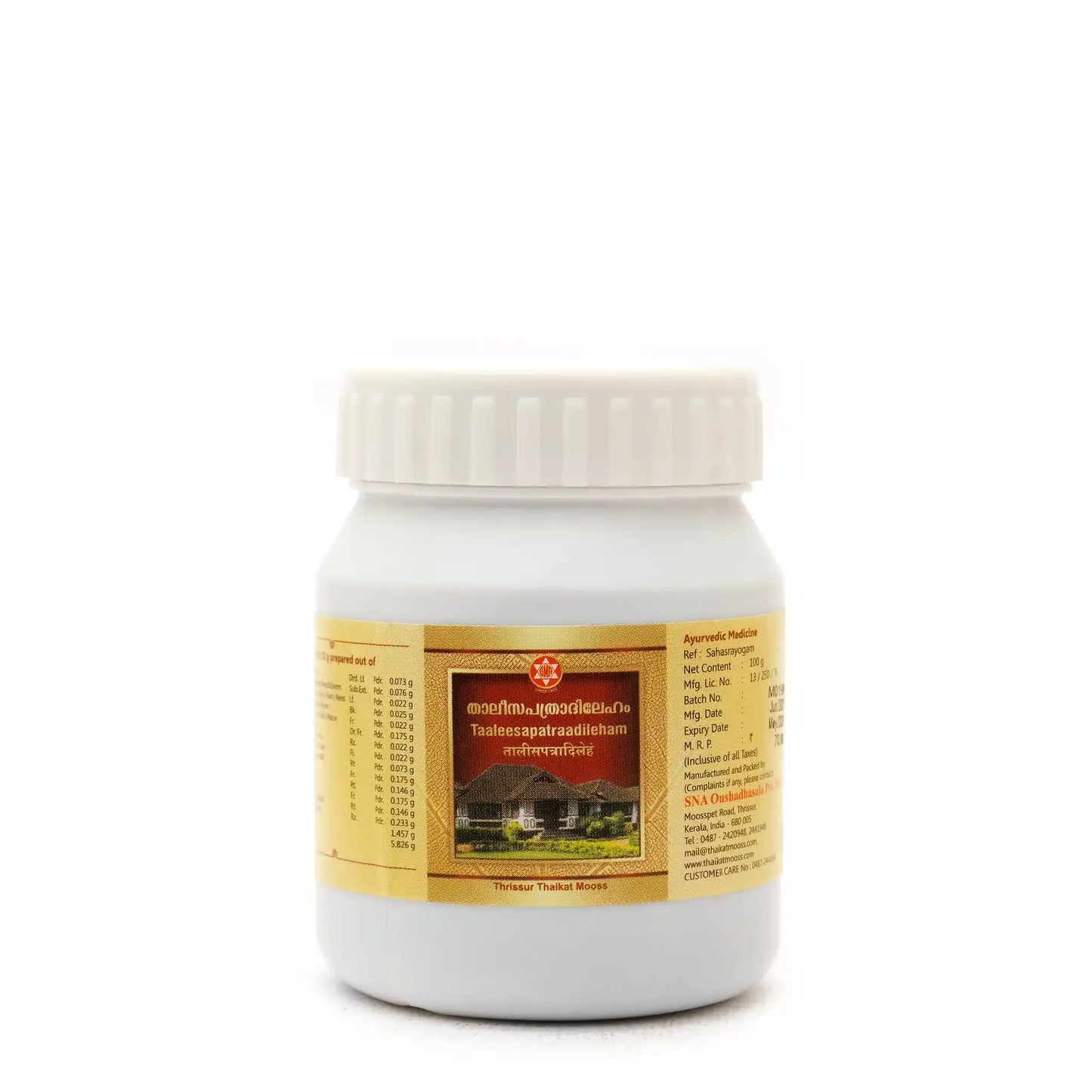
Taaleesapatraadi Leham – Classical Ayurvedic Leham for Asthma, Cough & Rhinitis | 100g
Couldn't load pickup availability
Taaleesapatraadi Leham – Classical Ayurvedic Leham for Asthma, Cough & Rhinitis | 100g
Taaleesapatraadi Leham is a classical Ayurvedic leham (electuary paste) formulation referenced in Sahasrayogam. The name reveals its primary herb: Taaleesapatra (Abies webbiana — Indian Silver Fir dried leaf) + Aadi (and others) + Leham (electuary paste) — a formulation built around Taaleesapatra as the lead respiratory herb, supported by a precisely calibrated blend of aromatic spices, warming herbs, and camphor, all bound in a sugar candy and honey base.
This formulation is a classical Ayurvedic respiratory leham — designed for conditions involving Kapha and Vata vitiation in the respiratory tract. The combination of Taaleesapatra (Indian Silver Fir), Star Anise, Pippali (Long Pepper in both fruit and root form), Shunti (Dry Ginger), Maricha (Black Pepper), Kushtha (Costus Root), and Camphor creates a powerful kaphahara (Kapha-reducing), shwasahara (anti-asthmatic), and kasahara (anti-tussive) formulation. Sugar candy and honey serve as the classical base and carriers. The smaller 100g pack makes it ideal for trial use and for conditions requiring shorter treatment courses.
Key Highlights
- Classical leham (electuary paste) per Sahasrayogam
- Primary herb: Taaleesapatra / Indian Silver Fir (Abies webbiana) – classical respiratory herb
- Traditionally indicated for asthma, cough, and rhinitis
- Contains Trikatu group (Pippali, Maricha, Shunti) for kaphahara and bioavailability
- Pippali used in dual form – fruit and root – as per classical formulation
- Camphor (Cinnamomum camphora sublimed extract) for aromatic respiratory support
- Sugar candy and honey as classical base and carriers (anupana)
- Vegan-friendly formulation – contains honey (not suitable for strict vegans)
- Available in 100g pack
Indications (Traditional Use)
- Asthma (Shwasa)
- Cough (Kasa)
- Rhinitis / nasal congestion (Pratishyaya)
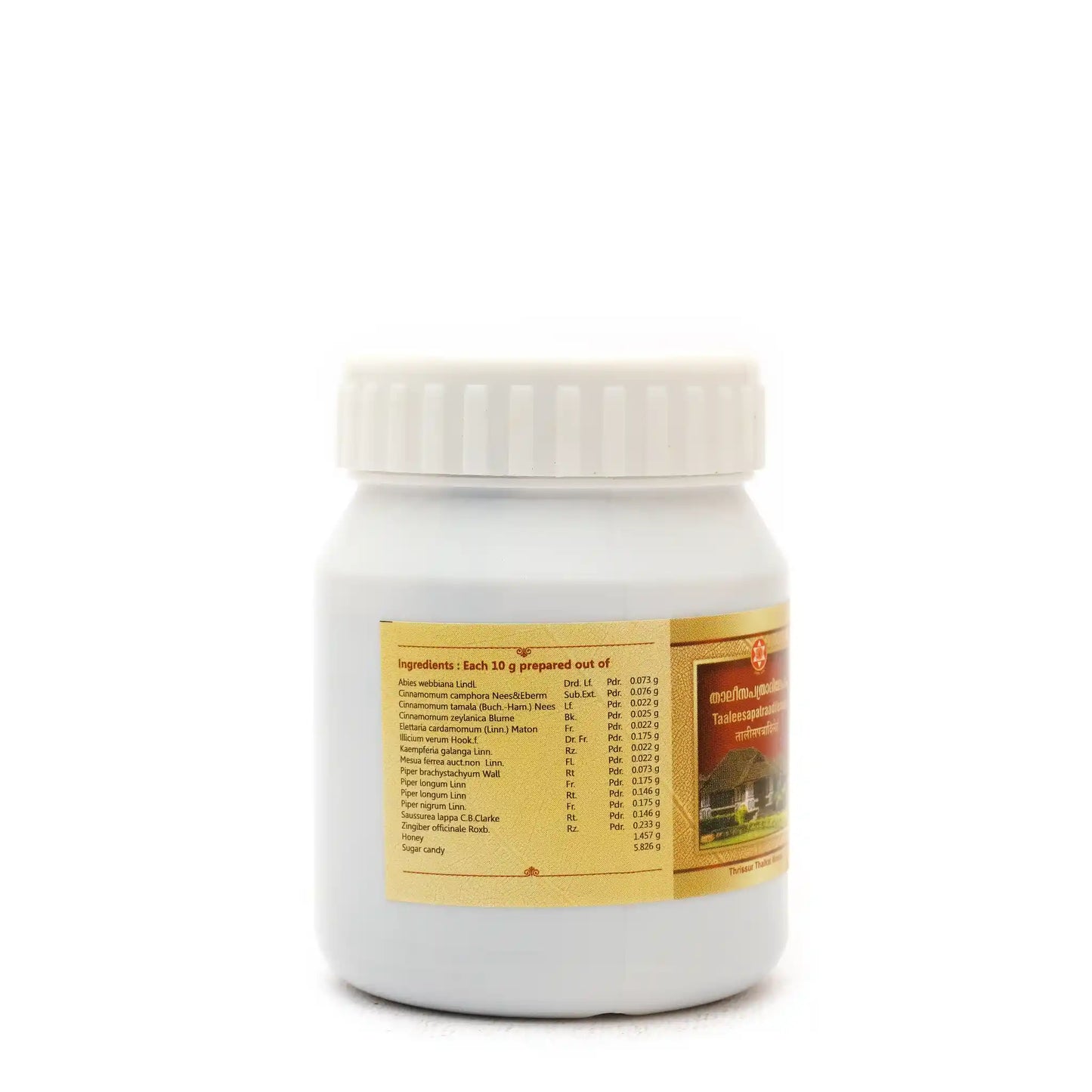
Ingredients – Each 10g Prepared From
Reference: Sahasrayogam
Powder (Churna) Ingredients
| Botanical Name | Common Name | Part Used | Qty/10g |
|---|---|---|---|
| Zingiber officinale Roxb. | Shunti / Dry Ginger | Rhizome | 0.233 g |
| Illicium verum Hook.f. | Star Anise / Thakolam | Dried Fruit | 0.175 g |
| Piper longum Linn. | Pippali / Long Pepper | Fruit | 0.175 g |
| Piper nigrum Linn. | Maricha / Black Pepper | Fruit | 0.175 g |
| Piper longum Linn. | Pippali Moola / Long Pepper Root | Root | 0.146 g |
| Saussurea lappa C.B.Clarke | Kushtha / Costus Root | Root | 0.146 g |
| Abies webbiana Lindl. | Taaleesapatra / Indian Silver Fir | Dried Leaf | 0.073 g |
| Piper brachystachyum Wall. | Chavya / Wild Pepper | Root | 0.073 g |
| Cinnamomum camphora Nees & Eberm. | Karpura / Camphor | Sublimed Extract | 0.076 g |
| Cinnamomum zeylanicum Blume | Twak / Cinnamon | Bark | 0.025 g |
| Cinnamomum tamala (Buch.-Ham.) Nees | Tejapatra / Indian Bay Leaf | Leaf | 0.022 g |
| Elettaria cardamomum (Linn.) Maton | Ela / Cardamom | Fruit | 0.022 g |
| Kaempferia galanga Linn. | Kachura / Aromatic Ginger | Rhizome | 0.022 g |
| Mesua ferrea auct. non Linn. | Nagakeshara / Ceylon Ironwood | Flower | 0.022 g |
Note: Piper longum (Pippali) is used in two parts — fruit (0.175g) and root (0.146g) — as per the classical Sahasrayogam formulation.
Base & Carrier Ingredients
| Ingredient | Role | Qty/10g |
|---|---|---|
| Sugar Candy (Mishri / Khanda Sharkara) | Primary base / cooling sweetener | 5.826 g |
| Honey (Madhu) | Natural sweetener / anupana (carrier) | 1.457 g |
This formulation contains honey. Not suitable for strict vegans. Does not contain dairy, animal flesh, or any other animal-origin ingredients. Suitable for vegetarians and those avoiding dairy.
Dosage
5–10g, to be taken at intervals, or as directed by your Ayurvedic physician.
How to Use
- Take 5–10g (approximately 1–2 teaspoons) at intervals as directed by your Ayurvedic physician.
- May be taken with warm water or warm ginger tea to enhance the respiratory benefits.
- Dosage and frequency should be determined by a qualified Ayurvedic physician based on your constitution and condition.
- Store in a cool, dry place away from direct sunlight. Keep the bottle tightly closed after use.
- Best consumed before the date printed on the label.
Packaging & Shipping
- Available in a 100g food-grade bottle – ideal for trial use and shorter treatment courses.
- Shipped in protective outer packaging to prevent breakage in transit.
- Available for delivery across all pincodes in India.
- International shipping available — additional courier charges apply. Please check at checkout.
- Store below 30°C in a dry place, away from direct sunlight. Keep out of reach of children.
- Best consumed before the date printed on the label.
Frequently Asked Questions
Q1. What is Taaleesapatra and why is it the primary herb in this formulation?
Taaleesapatra (Abies webbiana — Indian Silver Fir dried leaf) is a classical Ayurvedic herb described as kaphahara (Kapha-reducing), shwasahara (anti-asthmatic), and kasahara (anti-tussive). It is one of the foremost herbs in classical Ayurvedic respiratory formulations, particularly for conditions involving Kapha accumulation in the respiratory tract. Its aromatic, warming properties make it especially effective for asthma, cough, and rhinitis.
Q2. Why does this formulation contain camphor (Karpura)?
Camphor (Cinnamomum camphora sublimed extract / Karpura) is included in this formulation as a classical kaphahara and shwasahara ingredient. In Ayurveda, camphor is used internally in very small, precisely measured quantities in formulations for respiratory conditions. It provides aromatic bronchodilatory support and enhances the overall respiratory action of the formulation. The quantity used (0.076g per 10g) is within the classical therapeutic range for internal use.
Q3. Why is Pippali (Long Pepper) used in both fruit and root form?
Pippali (Piper longum) is used in two parts in this formulation — fruit (0.175g) and root (0.146g). The fruit and root of Pippali have distinct phytochemical profiles and slightly different therapeutic emphases in classical Ayurveda. The fruit is primarily deepana (digestive stimulant) and kaphahara, while the root (Pippali Moola) has stronger shwasahara (anti-asthmatic) properties. Using both maximises the respiratory and bioavailability-enhancing benefits.
Q4. Is this suitable for children with asthma or cough?
Use in children must be strictly under the supervision of a qualified Ayurvedic physician who can assess the child’s constitution, condition, and determine appropriate dosage. Do not self-administer to children.
Q5. Do you offer bulk or institutional orders?
Yes, we welcome bulk and wholesale enquiries. Please contact us directly for pricing, certifications, and minimum order quantities.
⚠️ Disclaimer
This product is a classical Ayurvedic leham (electuary paste) formulation intended for oral consumption as per traditional Ayurvedic practice. The indications listed are based on classical Ayurvedic texts including Sahasrayogam and are provided for informational purposes only. This product is not intended to diagnose, treat, cure, or prevent any disease. Results may vary from person to person. This product has not been evaluated by the Food Safety and Standards Authority of India (FSSAI) or any other regulatory authority for the claims mentioned herein. Always consult a qualified Ayurvedic physician or licensed healthcare professional before use, especially if you are pregnant, nursing, have a known medical condition (including respiratory conditions), or are currently on medication. Discontinue use and seek medical advice if any adverse reaction occurs. Keep out of reach of children.
This product contains honey. Not suitable for strict vegans. Does not contain dairy, animal flesh, or any other animal-origin ingredients. Suitable for vegetarians and those avoiding dairy. This product contains camphor (Cinnamomum camphora sublimed extract) as an internal Ayurvedic ingredient in classical therapeutic quantities — do not use externally or exceed the recommended dosage.
Manufactured and marketed in compliance with the Drugs and Cosmetics Act, 1940 and Rules thereunder, as applicable to Ayurvedic, Siddha, and Unani (ASU) medicines.
Out of stock